IRS Schedule C Expense Categories
Schedule C is the IRS form where sole proprietors and single-member LLCs report business expenses. There are 20 categories. If you're freelancing or contracting, every deductible expense you claim fits into one of them.
Here's the full list with short explanations and example receipts for each.
1. Advertising
Anything you spend to promote your business.
Examples: Facebook/Google Ads, business cards, flyers, sponsored posts.
2. Car and Truck Expenses
Business use of your vehicle. You can deduct actual expenses (gas, insurance, repairs) or use the standard mileage rate, but not both. Keep a mileage log either way.
Examples: Gas, oil changes, car insurance, parking fees, tolls.
3. Commissions and Fees
Payments to non-employees for sales or services, plus platform and transaction fees.
Examples: Referral fees, Stripe/PayPal processing fees, marketplace seller fees.
4. Contract Labor
Payments to independent contractors. If you paid someone $600+ in a year, you'll need to file a 1099-NEC for them too.
Examples: Freelancer invoices, subcontractor payments, virtual assistant fees.
5. Depletion
For natural resources you own (timber, minerals, oil). Most freelancers will never use this one.
Examples: Timber harvesting costs, mineral extraction, oil well operations.
6. Depreciation and Section 179
Deduct the cost of business assets over time (depreciation) or all at once the year you buy them (Section 179). Think equipment, furniture, computers.
Examples: Laptops, camera gear, office furniture, machinery.
7. Employee Benefit Programs
Benefits you provide to employees (not yourself as a sole proprietor). Health insurance, life insurance, dependent care, etc.
Examples: Group health premiums, retirement plan contributions, dependent care costs.
8. Insurance (Other Than Health)
Business insurance premiums. Health insurance goes elsewhere on the return, and vehicle insurance goes under Car and Truck Expenses.
Examples: General liability, professional liability (E&O), business property insurance, workers' comp.
9. Interest
Interest on business debts, including business loans, credit lines, and mortgages on business property.
Examples: Business loan interest, business credit card interest, mortgage interest on office space.
10. Legal and Professional Services
Fees paid to lawyers, accountants, and other professionals for business-related work.
Examples: CPA fees, attorney fees, bookkeeping, tax prep, consultant invoices.
11. Office Expenses
Small, consumable stuff you use up within the year. Bigger equipment goes under Depreciation instead.
Examples: Paper, ink, pens, postage, cleaning supplies, small desk accessories.
12. Pension and Profit-Sharing Plans
Contributions to employee retirement plans (SEP-IRA, SIMPLE IRA, etc.). Your own retirement contributions as a sole proprietor go on a different line.
Examples: Employer-match contributions, plan admin fees, plan setup costs.
13. Rent or Lease
Rent for business property you don't own. The form splits this into (a) vehicles/machinery/equipment and (b) other property like office space.
Examples: Coworking membership, office lease, equipment rentals, vehicle leases.
14. Repairs and Maintenance
Fixing or maintaining business property and equipment. Improvements that add value get capitalized instead of deducted here.
Examples: Computer repairs, office plumbing/electrical, equipment servicing, printer maintenance.
15. Supplies
Materials consumed in running your business. Similar to office expenses but broader, covering anything used up in delivering your work.
Examples: Raw materials, packaging, shipping supplies, project-specific consumables.
16. Taxes and Licenses
Business taxes and licensing fees. Federal income tax and self-employment tax don't count here.
Examples: Business license fees, professional license renewals, business property tax, state franchise tax.
17. Travel
Business travel when you're away from home overnight. Transportation, lodging, incidentals. Meals during travel go under Meals instead.
Examples: Flights, hotels, train tickets, rental cars, baggage fees, rideshares to client sites.
18. Meals
Business meals with a client, customer, or associate. Usually 50% deductible. Write down who you met with and what you discussed.
Examples: Client dinners, coffee meetings, working lunches, conference meals.
19. Utilities
Utility costs for your business space. Home office? You'll deduct a portion based on how much of your home you use for work.
Examples: Electricity, internet, phone (business portion), water and gas for a dedicated office.
20. Wages
Pay for employees. Contractors go under Contract Labor. You can't deduct what you pay yourself as a sole proprietor.
Examples: Payroll records, W-2 statements, direct deposit confirmations, payroll service invoices.
How ReceiptMatrix Handles This
ReceiptMatrix reads vendor names, amounts, and tax from each receipt, then suggests a Schedule C category. When you correct a suggestion, it remembers for next time, so recurring vendors like "Staples" or "Adobe" get categorized correctly going forward.
Everything runs locally on your Mac. No receipt data leaves your machine.
If you want the main app documentation instead of this tax reference, start in the Help Center.
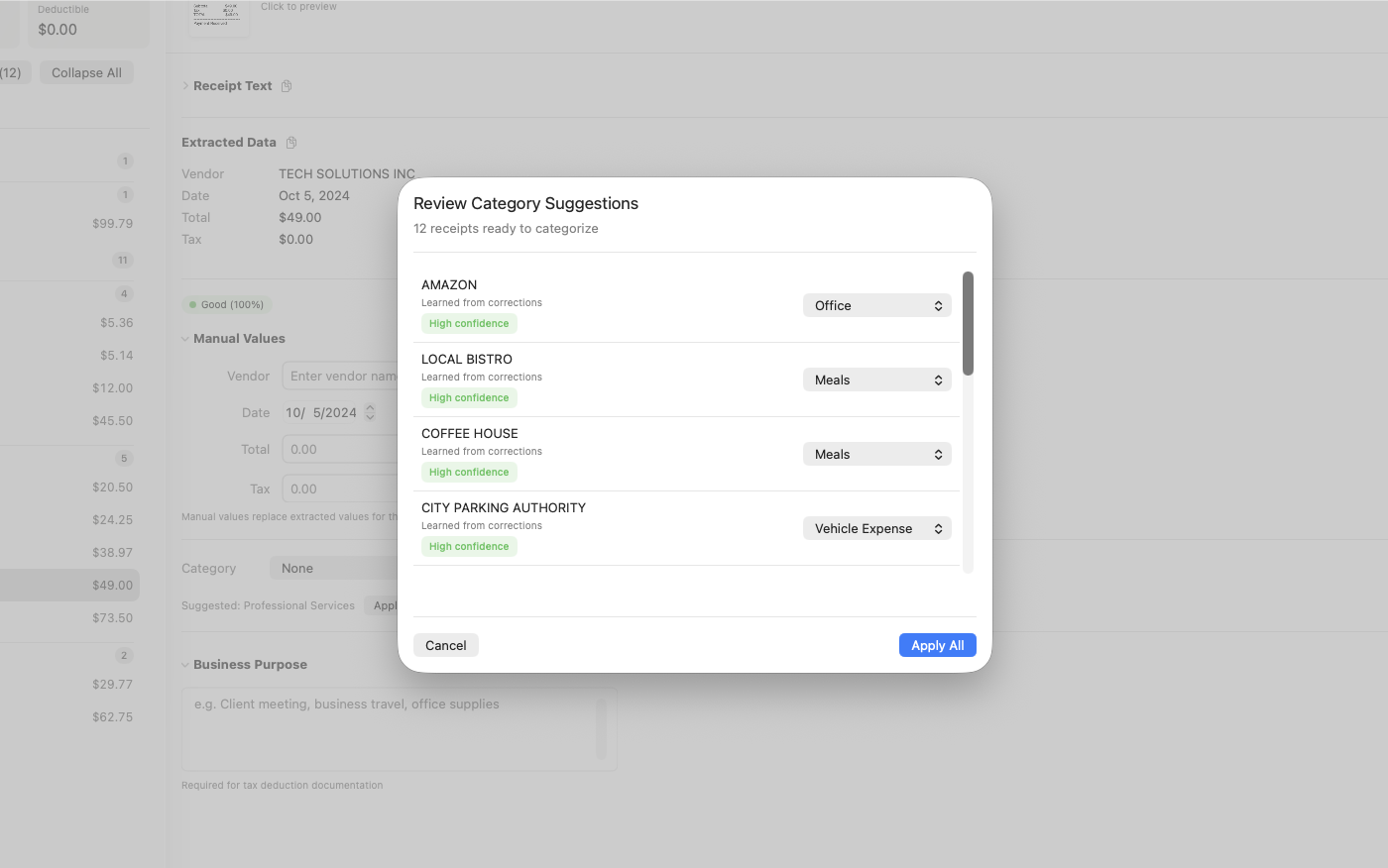
Once your receipts are categorized, you can export them as CSV, PDF, or a Tax ZIP organized by category.
See also: Freelancer's guide to receipt organization.